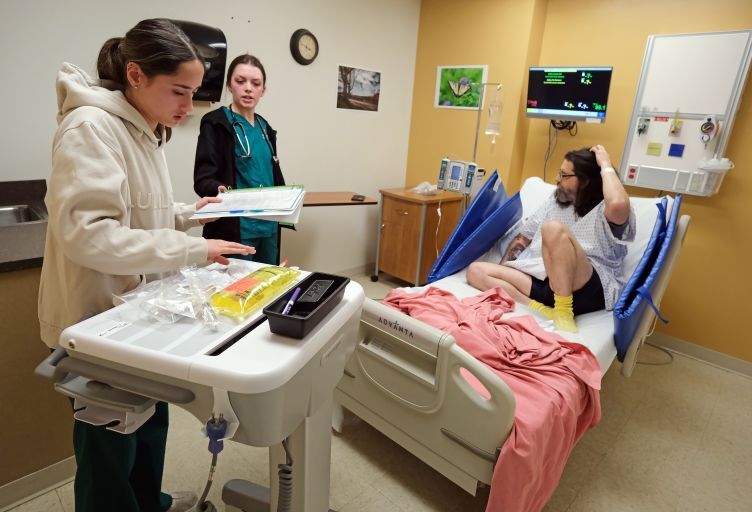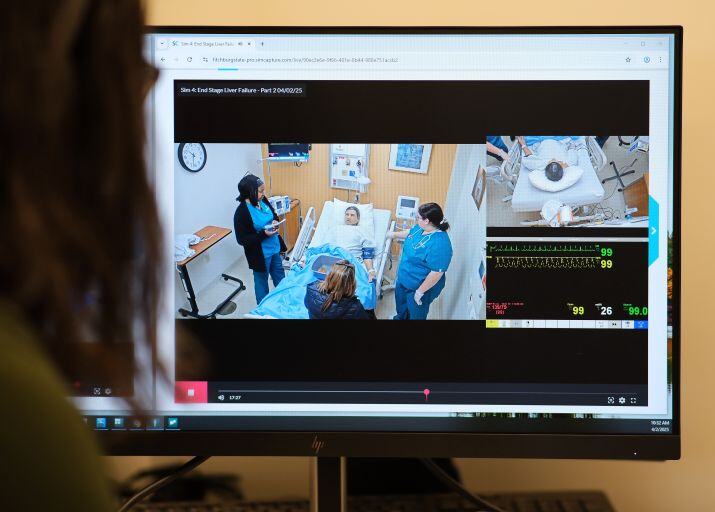
Nursing Simulation Lab Director Ian Murray steps in to play the role of James Irons, a recovering alcoholic who may have relapsed and ended up in the hospital. James is complaining of itching from bed bugs, and seeing red squirrels in the room.
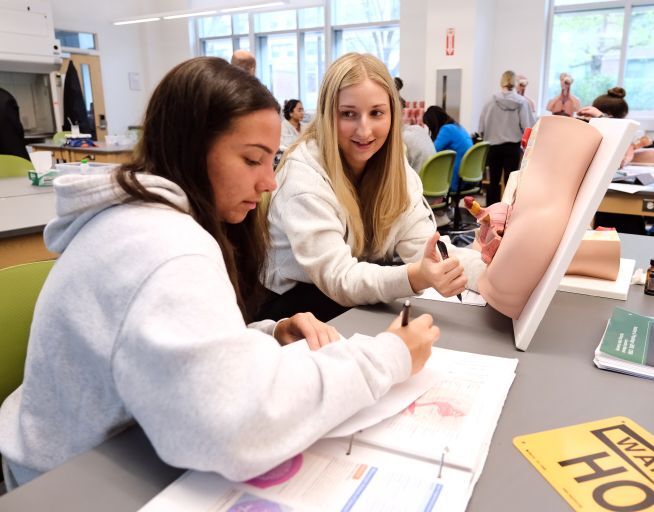
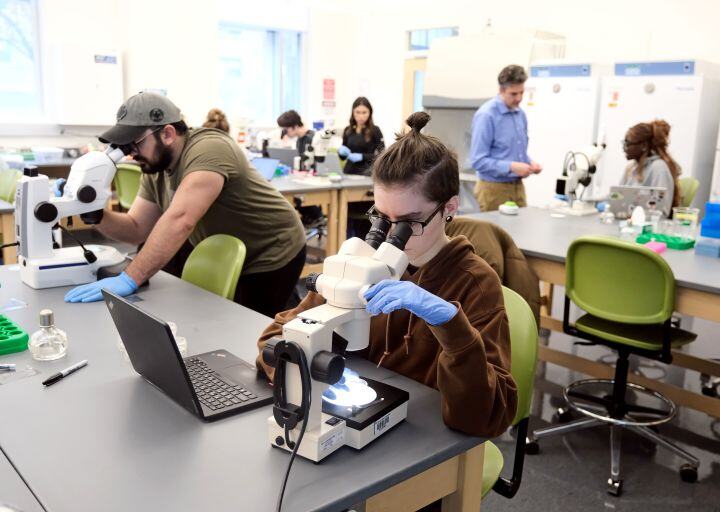
Students in Biology and Chemistry Professor Dr. Sean Rollins' Medical Microbiology course performed various procedures in their lab in the Antonucci Science Complex. The course serves as an introduction to the biology of major groups of micro-organisms including bacteria, viruses, protozoa, and fungi. Emphasis is placed on their relationship to man as agents of infectious diseases. In the laboratory principles and practices of aseptic techniques and diagnostic identification and culture of disease entities are explored.
Topics: Health and Natural Sciences
Nursing students learn the various forms of respiratory interventions in their Nursing Foundations Lab.; results can be monitored with the aid of real-time feedback. In this course, emphasis is placed on professionalism, caring, communication, cultural considerations, spirituality, sexuality and health promoting activities.
Students in Biology Professor Christopher Picone General Biology II Lab are studying invertebrate anatomy, In this particular lab, the invertebrates being studied are earthworms and lobsters. Someone isn't fan of the lobster. 😁 The course examines principles of organismal biology. Topics include evolution, diversity, plant biology, and animal biology. The laboratory emphasizes hypothesis formation and data analysis.
Topics: Health and Natural Sciences
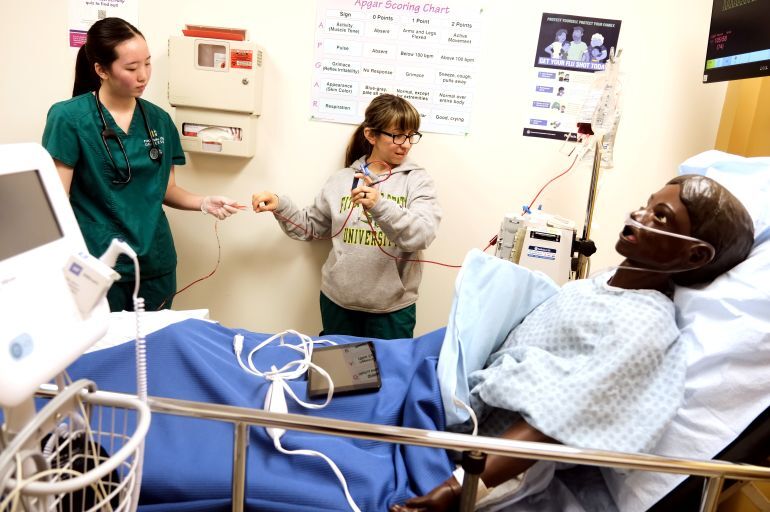
Our nursing students assessed the condition of a newborn in our Nursing Simulation Lab. Our Nursing Simulation Laboratory assists nursing students in learning critical thinking and clinical judgment skills in preparation for their healthcare careers. The “manikins” act as lifelike patient simulators, wherein instructors provide real-time feedback via a control center, giving students as close to real-life simulation as possible. Fellow students watch as their classmates work through the simulation. All students and faculty debrief after the scenario.
Students in Biology and Chemistry Professor Steven Fiedler's General Chemistry II Lab work on an assignment in the Antonucci Science Complex. In this course, topics include chemical, acid/base, and solubility equilibria and chemical kinetics.
Topics: Health and Natural Sciences
Nursing students learn the methods of, and importance of checking with, and informing, a patient before injecting ordered medications in their Nursing Foundations Lab. In this course, emphasis is placed on professionalism, caring, communication, cultural considerations, spirituality, sexuality and health promoting activities.
Environmental, Geographic and Public Health Sciences Professor Jiang Yu helps students with an experiment in her General Physics I course. This first-semester general college physics course consists of studies in the principle and application of classical mechanics, waves, sound and heat. Typical topics include description of motions, Newton's laws of motion, Kepler's law of planetary motion, universal gravitation, work and energy, conservation laws, temperature, heat, and laws of thermodynamics.
Yesterday afternoon, the university's Career Services and Advising Center sponsored a Health Sciences career fair in the Hammond Main Lounge. The program was open to all students in all majors, with a focus on positions in; nursing, biology, chemistry, and exercise and sports science.
In her continued effort to learn as much about Fitchburg State University as she can, President Donna Hodge recently joined Biology and Chemistry Professor Daniel Welsh for a tour of the university's Animal Care Facility. Dr. Welsh and students are currently studying the effects of turbidity ("cloudy water") on the reproductive behavior of the rainwater killifish (Lucania parva). Understanding how changes in water clarity may impact the ability to find mates and to successfully hatch eggs may provide insights into how changes in an animal's environment can impact its survival.