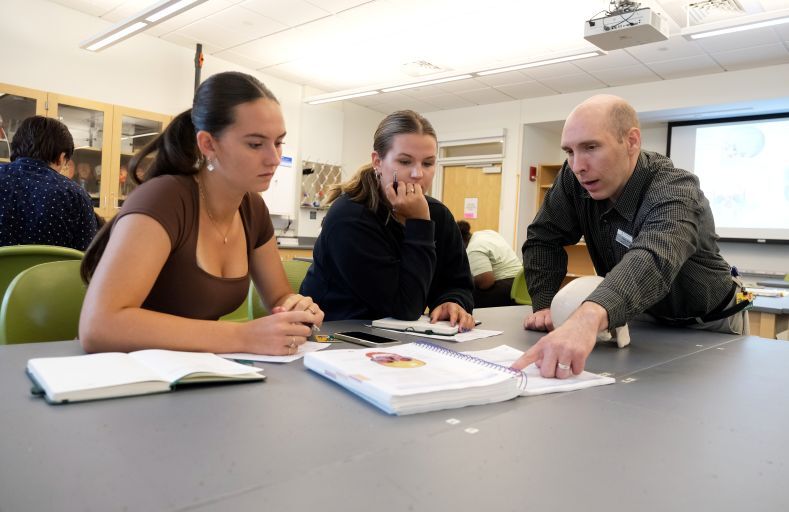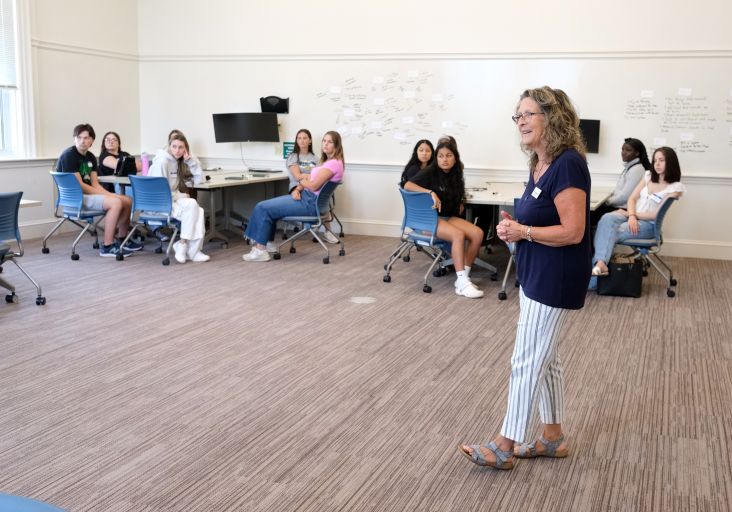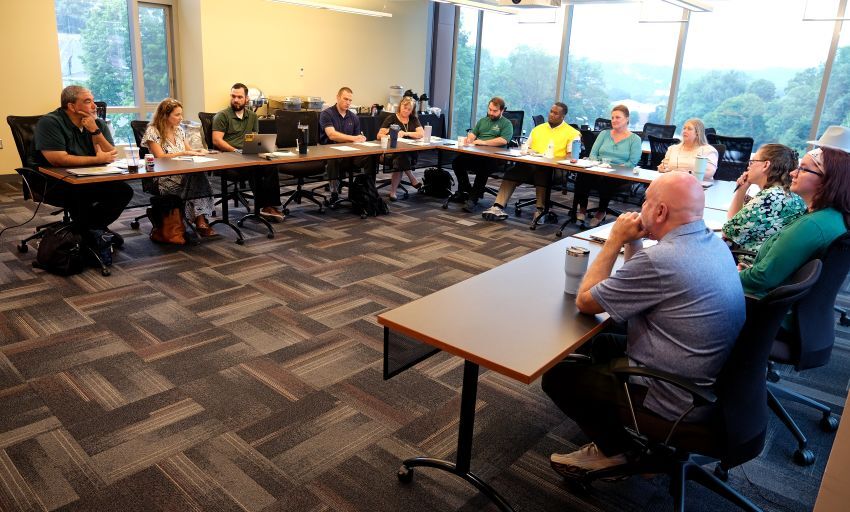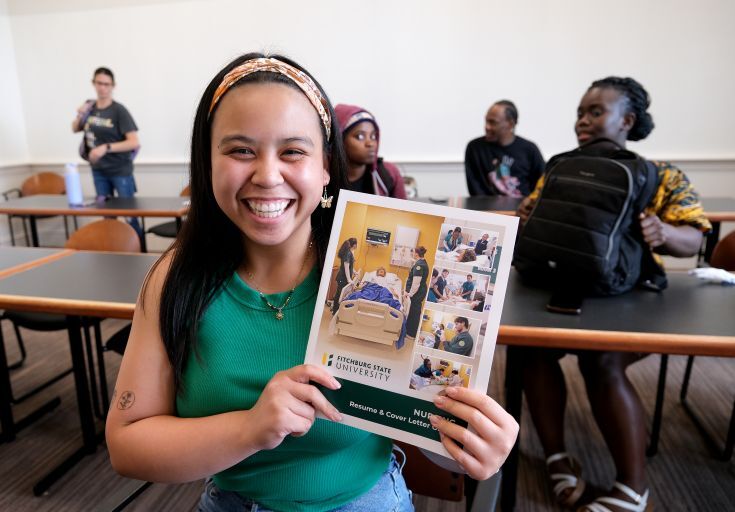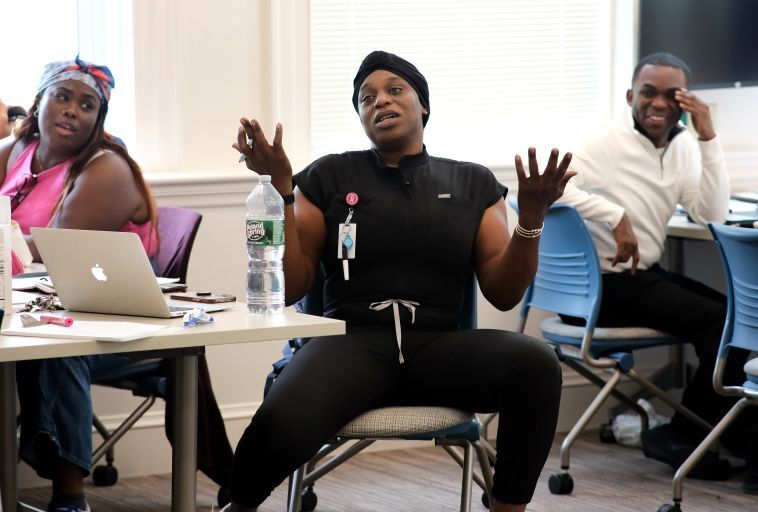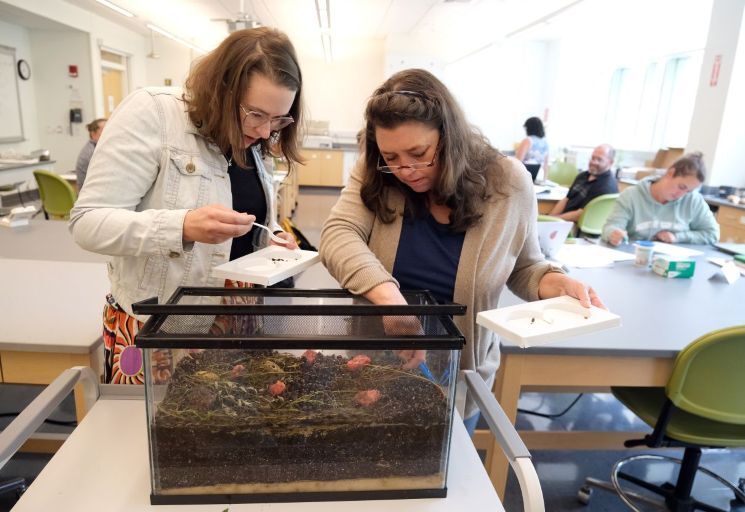
Junior nursing students take part in an Open Lab session in the Thompson Hall Nursing Education Center.
Our nursing students were immersed in a respiratory distress scenario for a pediatric patient. The understandably upset mom was played by Nursing Program Professor Deborah Benes. Our Nursing Simulation Laboratory assists nursing students in learning critical thinking and clinical judgment skills in preparation for their healthcare careers. The “manikins” act as lifelike patient simulators, wherein instructors provide real-time feedback via a control center, giving students as close to real-life simulation as possible. Fellow students watch as their classmates work through the simulation. All students and faculty debrief after the scenario.
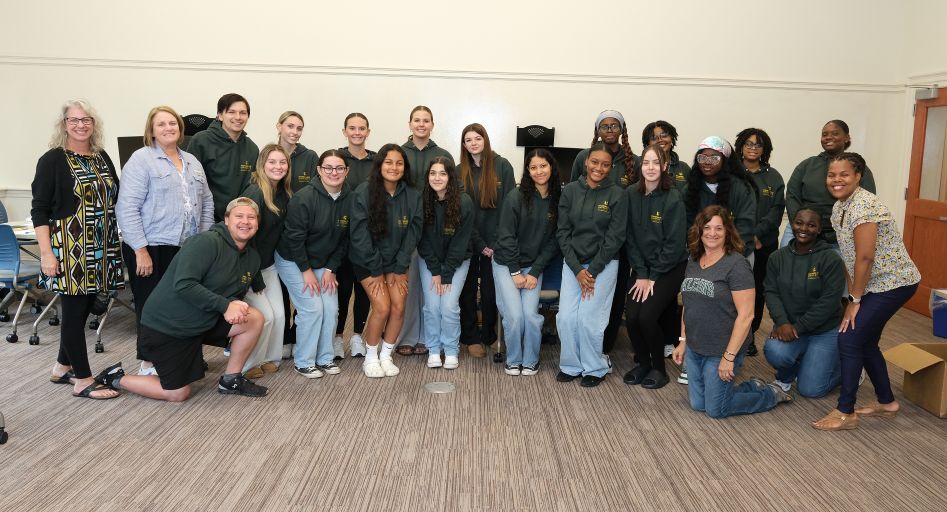
The Biology and Chemistry Club gathered in the Game Room hang out, play pool, and more.
Topics: Clubs and Organizations, Health and Natural Sciences
Students in Biology and Chemistry Professor Dennis Awasabisah's General Chemistry I Lab perform an experiment in the Antonucci Science Complex. The course explores the fundamental laws and theories of chemistry such as atomic structure, the periodic table, electrochemistry, descriptive inorganic chemistry, the gas laws, solutions, equilibrium calculations and chemical bonding. Chemical calculations are emphasized.
Topics: Health and Natural Sciences
Senior nursing students worked through a home hospice care scenario n our Nursing Simulation Lab. The scenario consisted of two parts. In part one, the team arrives to care for Erika, currently in home hospice whose understandably distraught sister has many concerns and questions. The team makes Erika comfortable and answers her sister's questions. In part two, Erika has passed and the team works through the process of disenrollment. Note - while two different teams are pictured, both teams worked through both part one & two.
Biology and Chemistry Professor Dr. Erin Rehrig took students in her Life Science for Educators class around campus to identify each of the four major plant classifications; Nonvascular plants (mosses), Seedless vascular plants (ferns) Gymnosperms (pine), and Angiosperms (flowering plants).
Students in Biology and Chemistry Professor Steven Fiedler's Physical Chemistry 1 Lab work on an experiment where they bring water to a boil at room temperature utilizing pressure in the Antonucci Science Complex. The course explores the underlying principles of chemistry from a physical chemistry standpoint. Topics of discussion include kinetic theory, theories of the structure of matter, theory of solutions, electrochemistry, thermodynamics, spectroscopy and kinetics.
Topics: Health and Natural Sciences
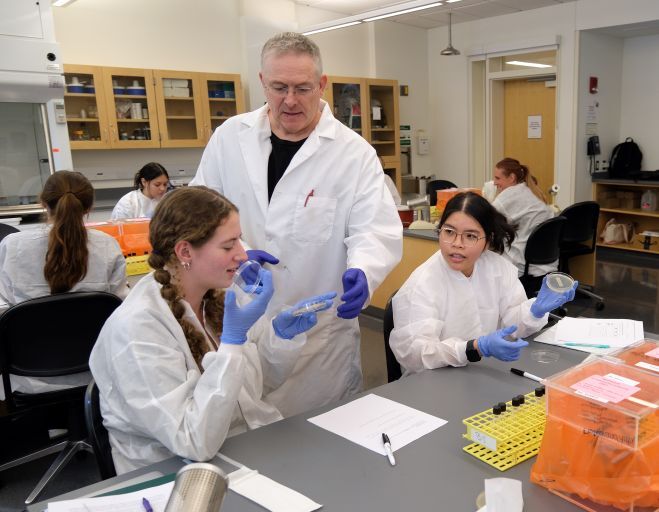
Students in Biology and Chemistry Professor Billy Samulak's General Chemistry Lab work on an experiment in the Antonucci Science Complex. The course explores the fundamental laws and theories of chemistry such as atomic structure, the periodic table, electrochemistry, descriptive inorganic chemistry, the gas laws, solutions, equilibrium calculations and chemical bonding. Chemical calculations are emphasized.
Topics: Health and Natural Sciences
Professor Ronald Krieser's genetics lab used a fluoroscope to identify mitochondria within cells that they manipulated at the Antonucci Science Building. Fluoroscopy is an imaging technique that uses X-rays to obtain real-time moving images of the interior of an object. Learn more about our Biology Programs here.
Topics: Health and Natural Sciences
Nursing students learn the methods of, and importance of wound care in their Nursing Foundations Lab. In this course, emphasis is placed on professionalism, caring, communication, cultural considerations, spirituality, sexuality and health promoting activities.